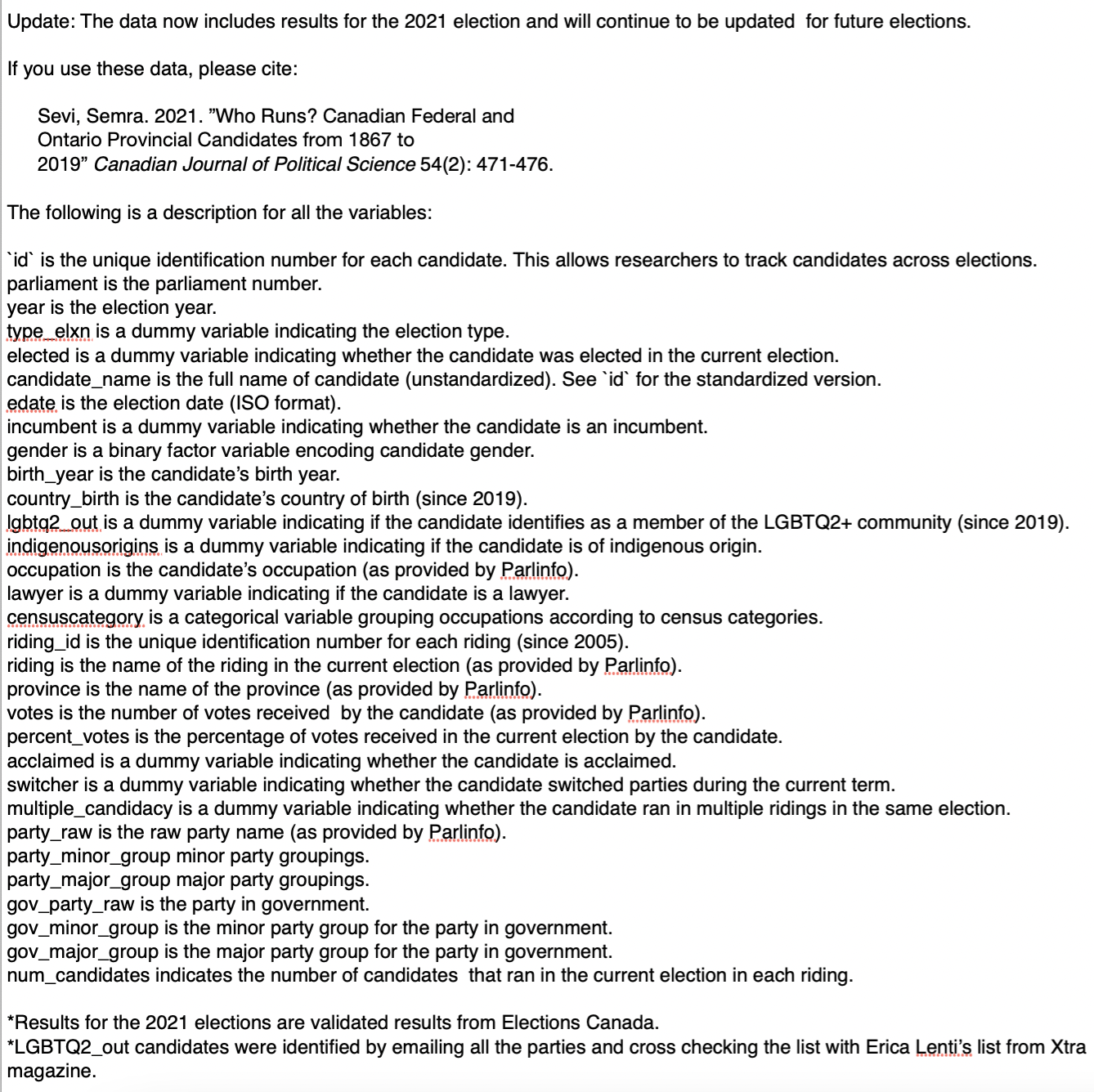
I built an original database detailing the district level data for all Canadian federal candidates since 1867, the largest collect of this kind. Unlike other datasets, I standardize candidate names across time (unique id) and provide the names of candidates, riding names, unique identification number for each riding, province, date of birth, gender, occupation, occupation categories, party affiliation, party categories, switchers, incumbency status, vote shares, raw votes, indigenous origins, candidates who identify as a member of the LGBTQ2+ community and so on. Here is a full list of all the variables and a description for each. I also collected similar data for all candidates in the Ontario provincial elections. You can find both datasets on the Harvard dataverse here.
If you are using these data, please cite: Sevi, Semra. 2021. “Who Runs? Canadian Federal and Ontario Provincial Candidates from 1867 to 2019” Canadian Journal of Political Science 54(2): 471-476.
Update: The data now includes results for the 2021 election and will continue to be updated for future elections.
These are the first publicly available comprehensive datasets of candidates election returns in Canada. The federal dataset is the first to standardize candidate names across elections by assigning unique id’s. This allows researchers to track candidates across elections. I first made the data publicly available in April 2019. It includes information on over 46,526 candidates who ran for federal elections and 15,500 for the Ontario provincial elections. These data can be used to answer a number of important questions on political diversity in Canadian politics. It can also be combined with other datasets.
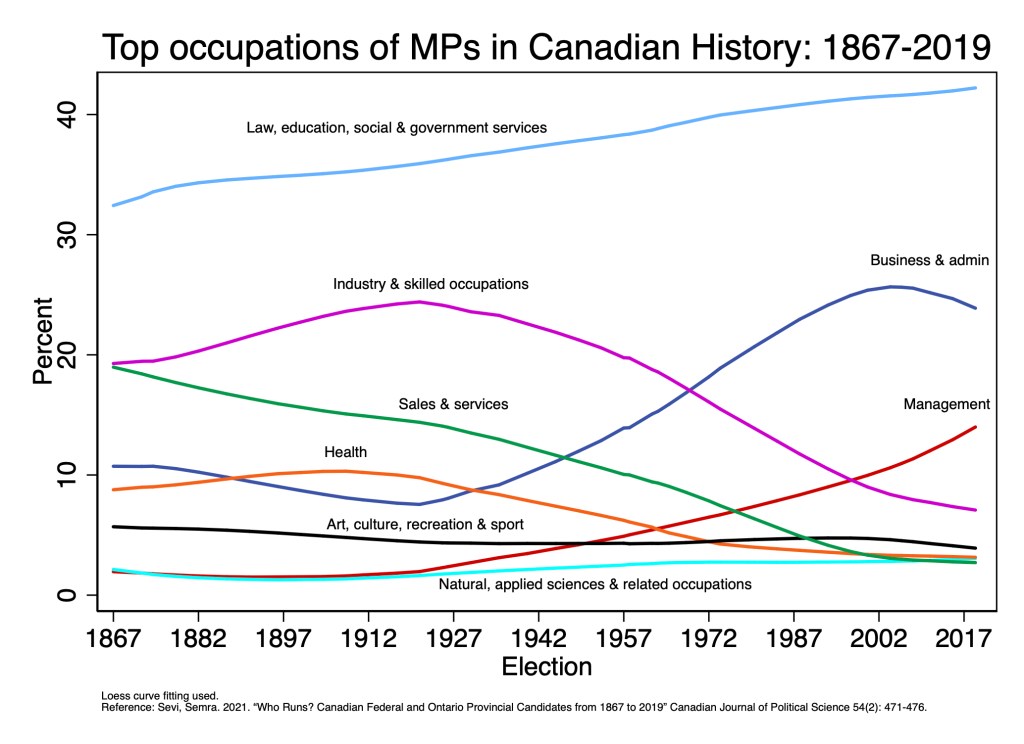
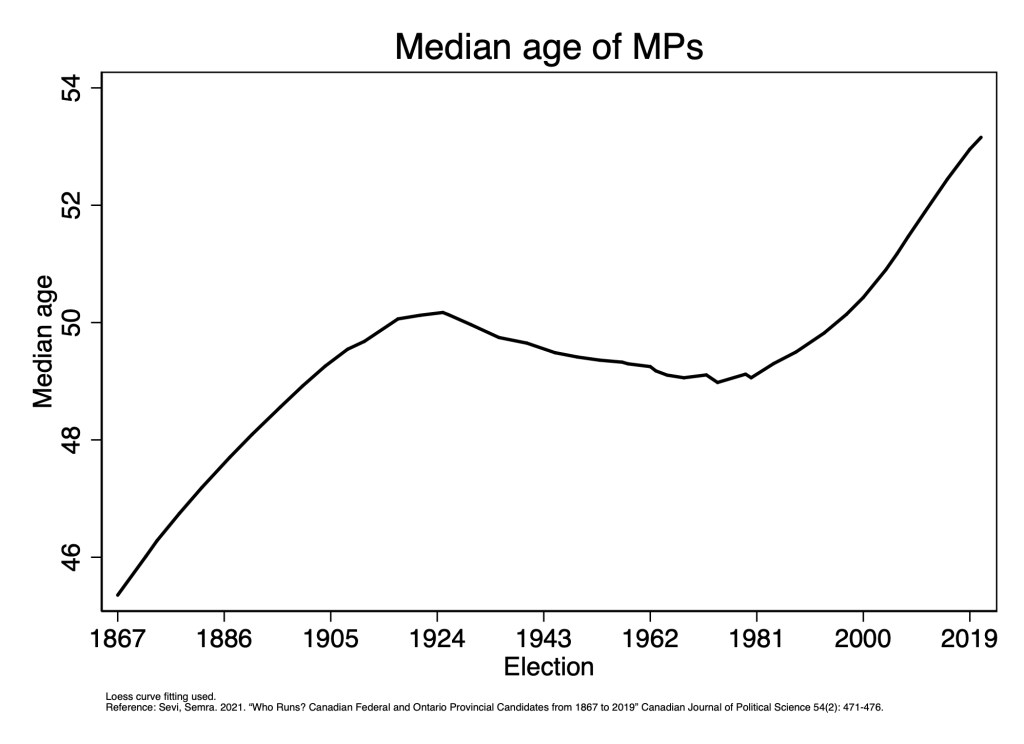
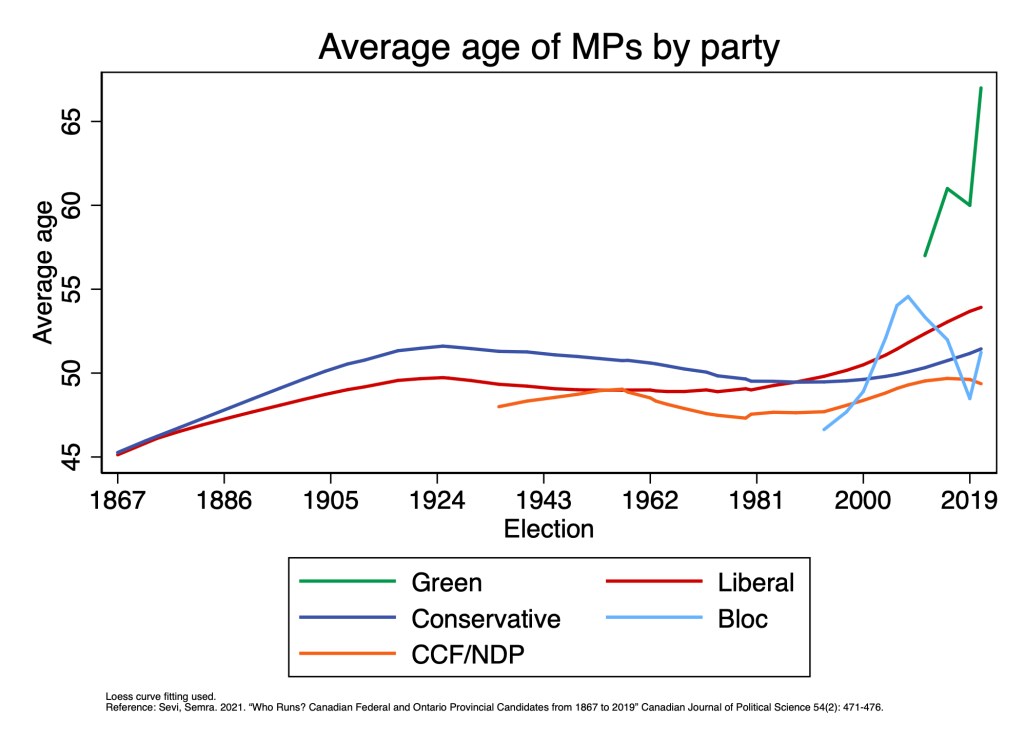
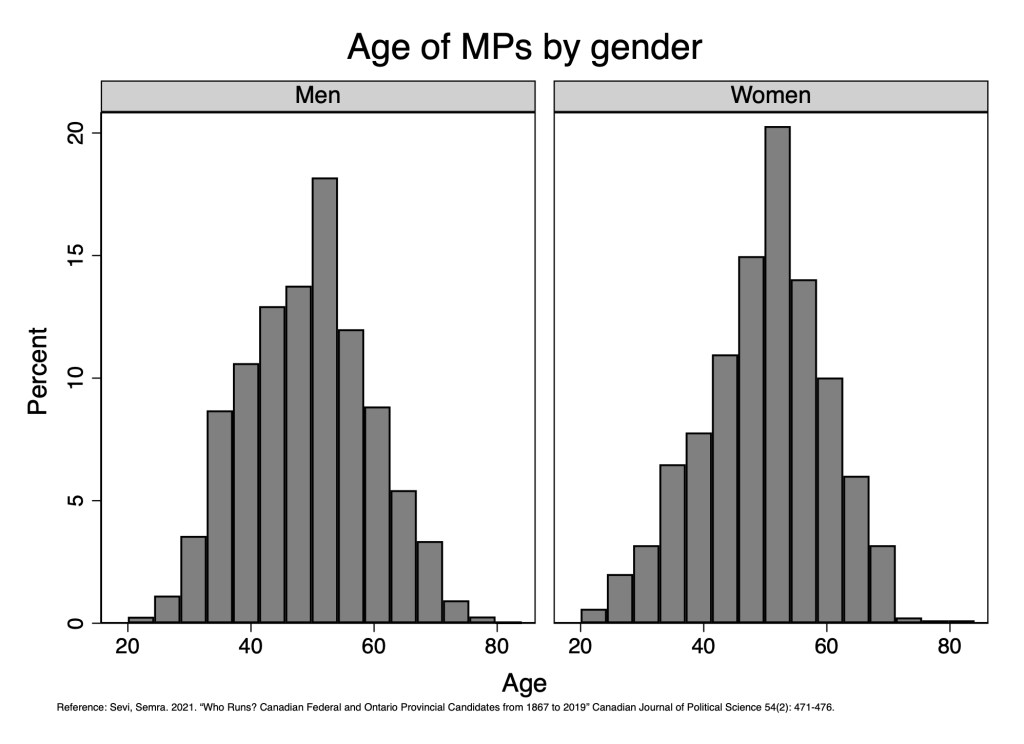
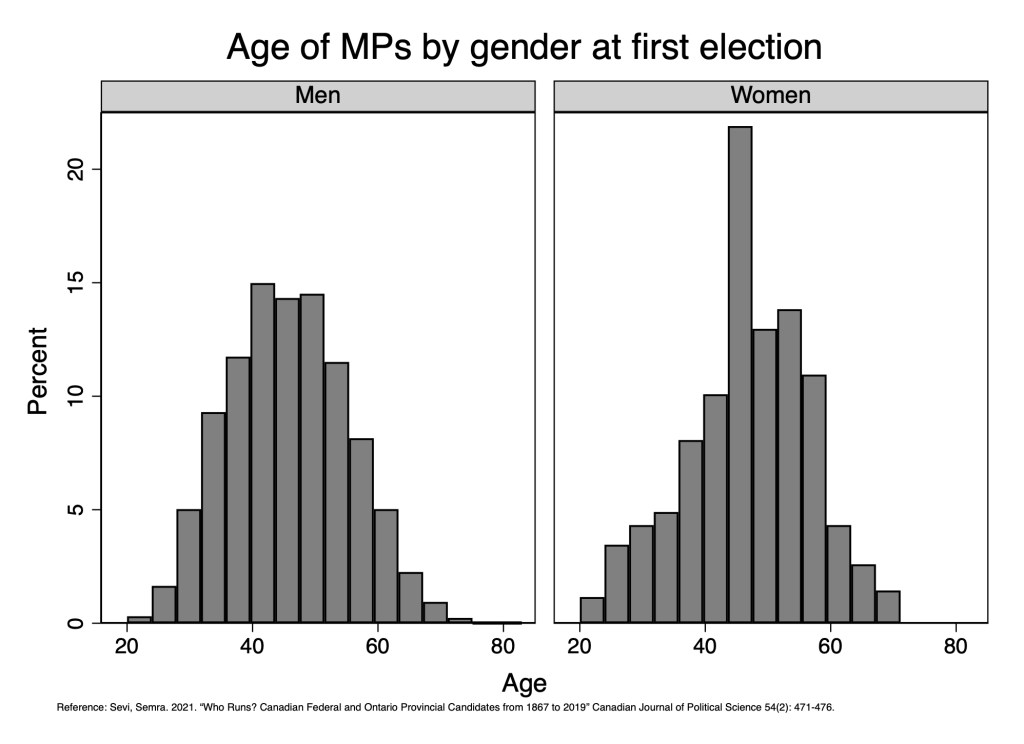
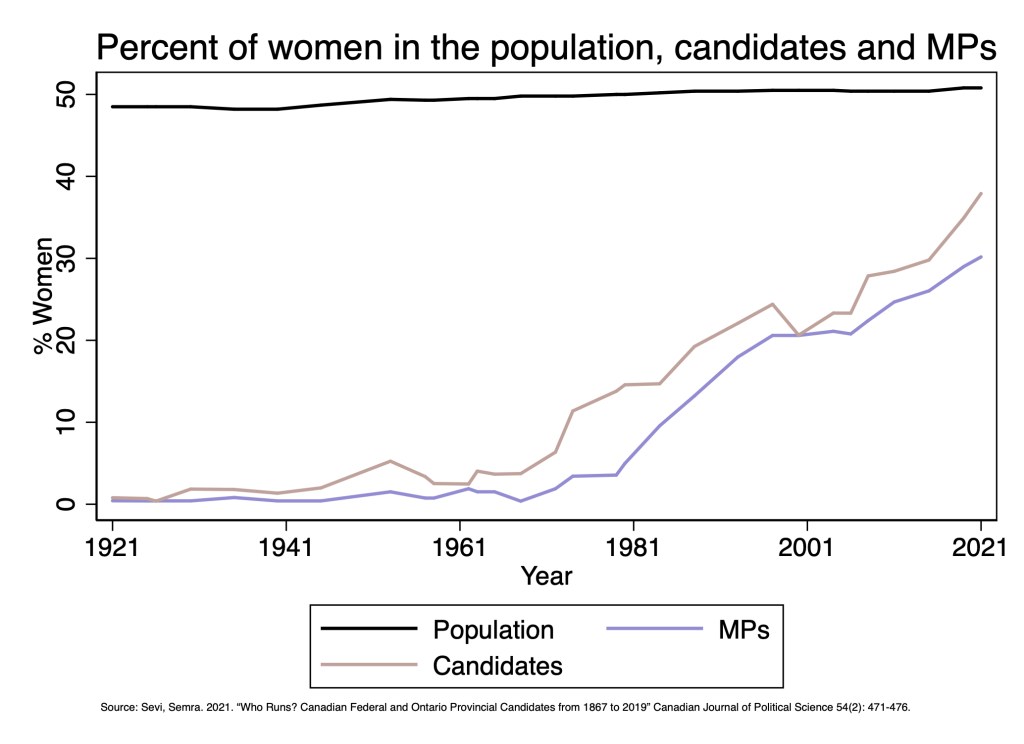
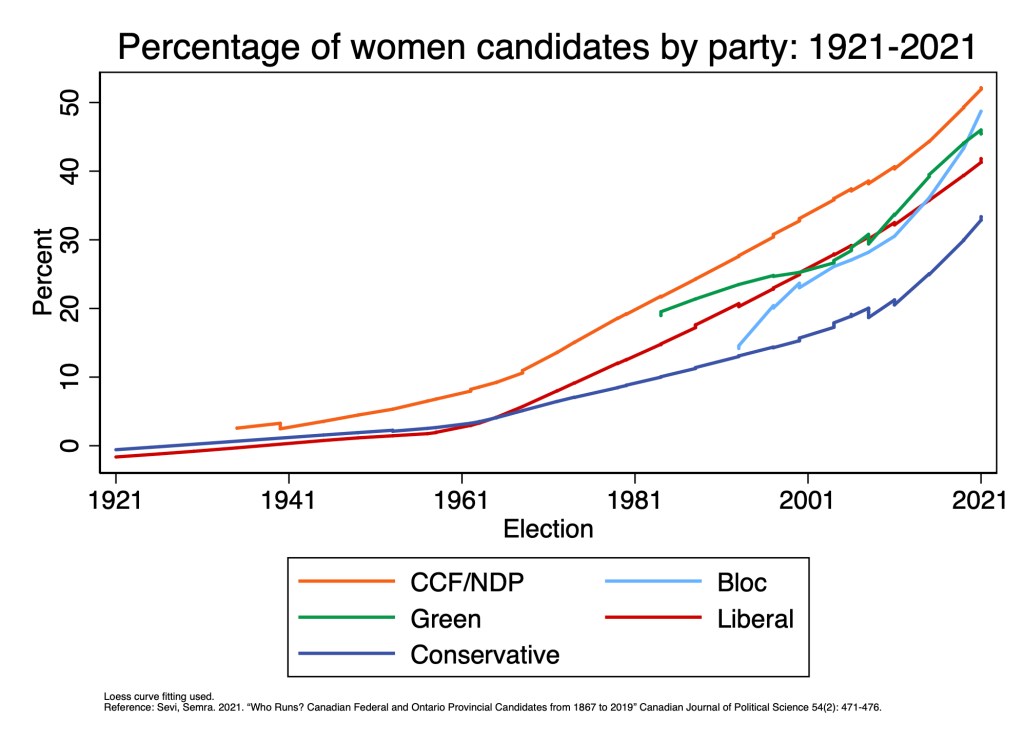
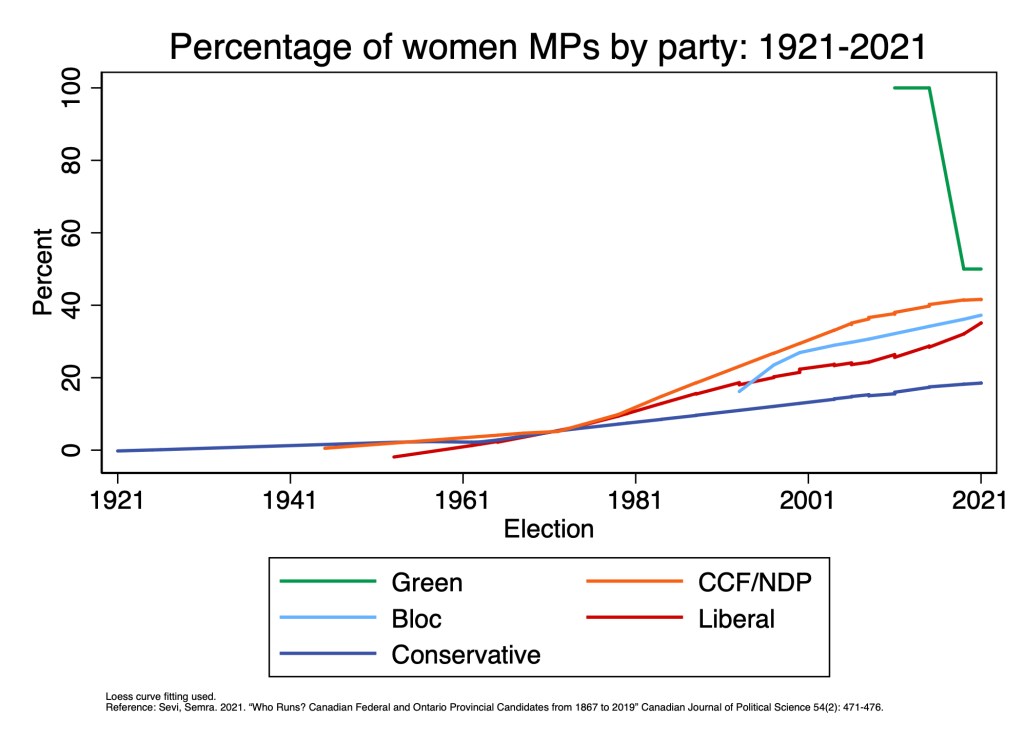
Here are some descriptives using the federal data:
Published peer-reviewed articles using these data (these are the ones I have written/co-written):
“Legislative Reciprocity: Using a Proposal Lottery to Identify Causal Effects” (with Donald P. Green) In Press at Political Science Research Methods.
“The incumbency advantage in Canadian elections” In Press at Canadian Journal of Political Science.
“Working-Class Descriptive Representation in Canada’s Federal Parties” (with Jacob Robbins-Kanter) In Robbins-Kanter, Jacob, Royce Koop, and Daniel Troup, eds. The Working Class and Politics in Canada. Vancouver: UBC Press.
The effects of proposal power on incumbents’ vote share: updated results from a naturally occurring experiment (with Donald P. Green) Political Science Research Methods.
Is Incumbency Advantage Gendered? Legislative Studies Quarterly.
Gender and Political Campaign Contributions in Canada. (with Erin Tolley and Randy Besco) Politics and Gender.
Who Runs? Canadian Federal and Ontario Provincial Candidates from 1867 to 2019 Canadian Journal of Political Science 54(2): 471-476. (2021)
Do Women Get Fewer Votes in Ontario Provincial Elections? (with André Blais and Vincent Arel-Bundock) In Roosmarijn de Geus, Erin Tolley, Elizabeth Goodyear- Grant, and Peter Loewen, eds. Women, Power, and Political Representation: Canadian and Comparative Perspectives. Toronto: University of Toronto Press. 2021.
Do Lawyers Get More Votes? (with André Blais and Danielle Mayer) American Review of Canadian Studies. 50(2): 216-228. (2020)
Do Women Get Fewer Votes? No (with Vincent Arel-Bundock and André Blais) Canadian Journal of Political Science 52(1): 201-210. (2019)
Legislative Party Switching and the Changing Nature of the Canadian Party System, 1867-2015 (with Antoine Yoshinaka and André Blais) Canadian Journal of Political Science 51(3): 665-695. (2018)
Published peer-reviewed articles using these data (others have written) that I am aware of. Please get in touch if I missed any:
Lapointe, Valérie, Benjamin Ferland, and Luc Turgeon. “Still sacrificial lambs? Yes! Minority groups in Canadian federal elections, 2015–2021.” Electoral Studies 87 (2024): 102717.
Rafie, Thomas. “Does working-class representation affect parties’ policy proposals? Evidence from post-war UK and Canadian parliaments.” (2024). MA thesis.
Gareau-Paquette, Thomas, Amanda Léal, Juliette Leblanc, Matthew Taylor, Virginie Vandewalle, and Ruth Dassonneville. “Voting for women in recent Canadian elections.” French Politics 22, no. 1 (2024): 45-63.
Weber, Anthony, Marc André Bodet, François Gélineau, and André Blais. “An election too far: Why do MPs leave politics before an election?.” Party Politics 30, no. 3 (2024): 493-504.
Rivard, Alex B., Jean-François Godbout, and Marc André Bodet. “Political Dynasties in Canada.” Government and Opposition (2024): 1-21.
Taylor, Zack, Jack Lucas, J. P. Kirby, and Christopher Macdonald Hewitt. “Canada’s Federal Electoral Districts, 1867–2021: New Digital Boundary Files and a Comparative Investigation of District Compactness.” Canadian Journal of Political Science/Revue canadienne de science politique 56, no. 2 (2023): 451-467.
Inspiration for other dataset publications:
Rivard, Alex B., Marc André Bodet, Jean-François Godbout, and Éric Montigny. “A Comprehensive Dataset of Four Provincial Legislative Assembly Members.” Canadian Journal of Political Science/Revue canadienne de science politique (2024): 1-7.
Taylor, Zack, Jack Lucas, J. P. Kirby, and Christopher Macdonald Hewitt. “Canada’s Federal Electoral Districts, 1867–2021: New Digital Boundary Files and a Comparative Investigation of District Compactness.” Canadian Journal of Political Science/Revue canadienne de science politique 56, no. 2 (2023): 451-467.
Lucas, Jack, Reed Merrill, Kelly Blidook, Sandra Breux, Laura Conrad, Gabriel Eidelman, Royce Koop, Daniella Marciano, Zack Taylor, and Salomé Vallette. “Women’s municipal electoral performance: An introduction to the canadian municipal elections database.” Canadian Journal of Political Science/Revue canadienne de science politique 54, no. 1 (2021): 125-133.
Johnson, Anna, Erin Tolley, Melanee Thomas, and Marc André Bodet. “A new dataset on the demographics of Canadian federal election candidates.” Canadian Journal of Political Science/Revue canadienne de science politique 54, no. 3 (2021): 717-725.
Baisley, Elizabeth, and Quinn M. Albaugh. “A New Dataset Identifying LGBTQ2S+ Candidates in Canadian Federal Elections.” Canadian Journal of Political Science/Revue canadienne de science politique (2025): 1-7.
Popular articles using these data:
Women in politics: To run or not to run? The Conservation. By: Semra Sevi
Women in the Parliament of Canada: 100 Years of Representation. Hill Notes. Library of Parliament. By: Clare Annett and Dominique Montpetit
Wilson-Raybould, Philpott face long odds as Independents – but not impossible ones. CBC News. By: Éric Grenier
Party Favours: How federal election candidates are chosen. The Samara Centre for Democracy
Resources with these data:
Data science with Python. Workshop given at the Computational and Data Systems Initiative at McGill University by Can Mekik
Data visualization with Python. Workshop given at the Computational and Data Systems Initiative at McGill University by Can Mekik
 Semra Sevi